
13 Jul How Big Is a 5×7 Photo? Inches, CM, Pixels & More
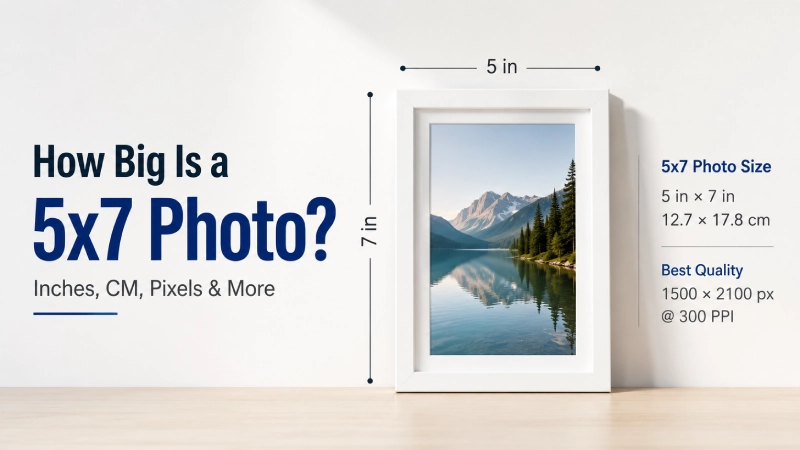
How big is a 5×7 photo? A standard 5×7 photo is 5 inches wide and 7 inches tall, equivalent to 12.7 × 17.8 centimeters. It is one of the most popular photo sizes for personal and professional printing for showcasing image details without overwhelming.
But before you print, it’s important to understand its exact dimensions, aspect ratio, and pixel requirements to avoid unwanted cropping or blurry results. This guide explains everything you need to know about 5×7 photo dimensions, pixels, aspect ratio, and printing requirements.
How Big is a 5x7 Photo?
A 5×7 photo measures 5 inches wide and 7 inches tall (or 7 inches wide and 5 inches tall in landscape orientation). In metric units, it equals approximately 12.7 × 17.8 cm.
However, this standard photo size is considered a medium-sized photo print that is larger than standard 4×6 prints but smaller than large display sizes such as 8×10 or 11×14. It offers a good balance between detail, portability, and display appeal.
Why Do So Many People Choose a 5x7 Photo?
Many people choose 5×7 photos because they offer an ideal balance of visibility and convenience. They are large enough to highlight facial features and add a premium presence to a tabletop display.
Other key reasons are:
- Portrait Orientation: The 5:7 aspect ratio is highly favored for headshots and family portraits because it naturally focuses the eye on the subject and retains enough background.
- Framing Flexibility: It is incredibly easy to find standard, ready-made frames for 5×7 prints online or in retail stores, best for gift-giving.
- Professional Appeal: Photographers often provide 5×7 prints for special events for their high-quality upgrade over casual snapshots, giving subjects greater visual importance.
- Affordable to Print: 5×7 prints offer a noticeable upgrade in size without a significant increase in printing costs compared to smaller formats.
Also, this photo size is suitable for family photos, travel memories, graduation pictures, pet photos, and so on.
5x7 Photo Dimensions in Different Units
Different 5×7 photo dimensions are as follows:
5x7 Photo Size in Inches
The standard dimensions of a 5×7 photo are 5 inches × 7 inches. Depending on the orientation, it can be printed as:
- Portrait orientation: 5 inches wide × 7 inches tall
- Landscape orientation: 7 inches wide × 5 inches tall
This measurement is the industry standard used by photo labs, frame manufacturers, and printing services worldwide.
5x7 Photo Size in Centimeters (cm)
A 5×7 photo measures approximately 12.7 cm × 17.78 cm.
Since many countries use the metric system for printing and framing, these dimensions are commonly used when ordering prints internationally or purchasing photo frames outside the United States.
- Portrait orientation: 12.7 cm × 17.78 cm
- Landscape orientation: 17.78 cm × 12.7 cm
5x7 Photo Size in Millimeters (mm)
In millimeters, a 5×7 photo measures 127 mm × 177.8 mm.
Millimeter measurements provide greater precision and are frequently used by professional print labs, photographers, and framing manufacturers for accurate sizing and custom print orders.
- Portrait orientation: 127 mm × 177.8 mm
- Landscape orientation: 177.8 mm × 127 mm
5x7 Photo Size in Feet
A 5×7 photo equals approximately 0.42 feet × 0.58 feet.
Although feet are rarely used for standard photo printing, this conversion can be useful when planning wall displays, gallery arrangements, or comparing photo sizes with larger prints and artwork.
- Portrait orientation: 0.42 ft × 0.58 ft
- Landscape orientation: 0.58 ft × 0.42 ft
While technically measured in feet, the 5×7 format remains a compact, medium-sized print that fits comfortably on desks, shelves, mantels, and small wall spaces.
How Big Is a 5x7 Photo in Pixels?
The pixel dimensions of a 5×7 photo depend on the pixels per inch (PPI) or dots per inch (DPI) used for printing or display. Higher PPI values produce sharper and more detailed prints because more pixels are packed into every inch of the image.
5x7 Photo at 72 PPI (Screen/web only)
At 72 PPI, a 5×7 photo measures: 360 x 504 pixels.
This resolution is best for digital displays, websites, emails, and social media previews rather than physical printing. While it may look acceptable on screens, printing a 72 PPI image usually results in heavily pixelated and blurry.
5x7 Photo at 150 PPI (Minimum print standard)
At 150 PPI, a 5×7 photo measures: 750 x 1,050 pixels.
This resolution offers reasonable print quality for casual use and can work well for prints viewed from a distance. This is acceptable, everyday-quality results for greeting cards or scrapbooks, though edges may appear slightly soft upon close inspection.
5x7 Photo at 300 PPI (Best print quality)
At 300 PPI, a 5×7 photo measures: 1,500 x 2,100 pixels.
This is the industry standard for professional photo printing and delivers excellent sharpness when viewing close ups, smooth gradients, and fine detail. Most professional photographers, print labs, and photo studios recommend using 300 PPI for high-quality 5×7 print Best for portrait photography, wedding prints, professional prints, and so on.
What Resolution Is Best for Printing a 5x7 Photo?
For the best print quality, a 5×7 photo should be printed at 300 PPI, which requires an image size of at least 1,500 × 2,100 pixels.
This resolution ensures:
- Sharp facial details and textures
- Smooth color transitions
- Crisp text and graphic elements
- Professional-quality print results
- Minimal risk of pixelation or blurriness
If the image will be viewed from farther away, such as in wall displays or event decorations, 150 PPI may still produce acceptable results. However, for portraits, framed photos, and professional photography, 300 PPI remains the recommended standard.
Things to Check Before Printing a 5x7 Photo
A 5×7 photo is considered a standard medium-sized print in the photography and printing industry. Below, we’ve highlighted some important considerations that you must check out:
Understanding the 5:7 Aspect Ratio
A 5×7 photo uses a 5:7 aspect ratio, meaning the width and height maintain a proportional relationship of 5 units to 7 units.
This ratio creates a classic rectangular shape that works particularly well for:
- Portrait photography
- Family photos
- Wedding pictures
- Travel photography
- Framed displays
However, many modern cameras and smartphones capture images in different ratios, such as 2:3, 4:3, or 16:9, which means some adjustment is often necessary before printing.
Why Cropping Happens
Cropping occurs when the original image aspect ratio does not match the 5:7 print dimensions.
For example:
- A DSLR image captured in 2:3 format may lose small portions from the top and bottom.
- A smartphone photo using a 4:3 ratio may require trimming from the sides or edges.
- Wide-angle images captured in 16:9 format usually need more significant cropping.
Without reviewing the crop beforehand, important elements such as faces, hands, text, or background details may be unintentionally removed during printing.
How to Keep Your Photo Looking Natural
A few simple adjustments can preserve the original look and composition of your image:
- Crop the image to a 5:7 ratio manually before uploading it for printing.
- Leave extra space around important subjects when taking the photo.
- Keep people, text, and key objects away from the edges of the frame.
- Use the print preview tool provided by your printer or photo lab.
- Avoid excessive zooming or stretching to fit the print dimensions.
Taking control of the crop yourself almost always produces better results than relying on automatic printer adjustments.
Common Printing Mistakes to Avoid
The most common printing mistakes are as follows:
- Printing low-resolution images that appear blurry or pixelated.
- Ignoring aspect ratio differences and allowing automatic cropping.
- Placing important subjects too close to the edges.
- Choosing incorrect paper settings or print quality options.
- Using heavily compressed images downloaded from social media.
- Skipping the print preview before placing an order.
- Printing without checking image brightness, contrast, and color balance.
Where Does a 5x7 Photo Work Best?
Below, we’ve shared common use cases where a 5×7 photo works best:
Portrait Photography
The 5×7 size is one of the most popular choices for portrait photography. It provides enough space to showcase facial expressions, clothing details, and background elements without feeling oversized. For example, individual portraits, senior photos, graduation pictures, and professional headshots.
Family Photos
Family photographs benefit greatly from the 5×7 format because it balances visibility and practicality. Multiple faces remain clear and recognizable while the print stays compact enough for desks, shelves, and family photo collections.
Photo Albums
A 5×7 print fits comfortably into many premium photo albums and memory books. The larger size allows viewers to appreciate details that may be lost in smaller prints while still keeping the album portable and easy to store.
Greeting Cards & Invitations
The dimensions of a 5×7 photo closely match many standard card and invitation formats, making it a popular choice for:
- Wedding invitations
- Holiday cards
- Birth announcements
- Graduation invitations
- Thank-you cards
- Anniversary celebrations
The size provides plenty of space for both images and printed messages without appearing crowded.
Framed Displays
A 5×7 photo creates an attractive framed display without dominating the surrounding space. It works well with tabletop, floating, easel, and wall-mounted frames in both homes and offices.
Because 5×7 is a standard print size, finding matching frames is simple and affordable.
Gifts
Personalized photo gifts often use the 5×7 format because it feels more substantial than smaller prints while remaining easy to package and display. It is a popular option for birthdays, anniversaries, weddings, Mother’s Day, Father’s Day, and holiday presents.
Home & Office Decoration
The medium-sized dimensions of a 5×7 print make it ideal for decorating:
- Desks and workstations
- Bookshelves
- Bedside tables
- Fireplace mantels
- Reception areas
- Office cabinets
It adds personality to a space without requiring the wall space of larger prints.
Small Gallery Walls
A 5×7 photo is an excellent choice for gallery wall arrangements. Multiple prints can be grouped to create visual interest without overwhelming the room.
Photographers and interior designers often combine several 5×7 prints with larger statement pieces to create balanced and visually appealing layouts.
5x7 vs Other Popular Photo Sizes
The key differences between 5×7 and other popular and most used photo sizes are discussed below:
5x7 vs 4x6 photo
1. Compact and everyday-friendly size
The 4×6 photo is considered the standard print size for casual photography and everyday memories. Its compact dimensions make it easy to carry, store, and share without taking up much space. It fits comfortably in albums, scrapbooks, and small tabletop frames.
2. Aspect ratio
A 4×6 photo uses a 2:3 aspect ratio, which matches the native ratio of many DSLR and smartphone cameras. Because of this, images often require little to no cropping before printing.
3. Common use cases
4×6 prints are commonly used for:
- Family snapshots
- Vacation photos
- School pictures
- Photo albums and scrapbooks
- Greeting cards and postcards
- Event giveaways and souvenirs
4. Print cost and availability
Since 4×6 is one of the most widely printed photo sizes worldwide, it is also one of the most affordable. Almost every photo lab, kiosk, printer, and online printing service offers 4×6 prints, often in bulk packages at low prices.
5. Framing and display options
The size works best for desk frames, mini galleries, refrigerators, and album inserts rather than large wall displays. Its smaller dimensions prioritize convenience over visual impact.
6. Cropping considerations
Because many cameras capture images in a similar ratio, photographers usually preserve the full composition without sacrificing edges or important details.
5x7 vs 8x10 photo
The 8×10 photo sizes differ from 5×7 in several ways:
1. Large and professional-looking print size
The 8×10 photo falls into the large-print category and has a significantly greater visual presence than standard photo prints. The larger dimensions make details more noticeable, especially in portraits and studio photography.
2. Aspect ratio
An 8×10 print uses a 4:5 aspect ratio, giving it a more balanced and slightly squarer appearance than traditional camera formats. Images captured in 2:3 or 4:3 ratios typically require cropping to fit this size.
3. Common use cases
8×10 photos are frequently chosen for:
- Professional portraits
- Corporate headshots
- Graduation photos
- Wedding portraits
- Studio photography
- Portfolio prints
- Framed home decor
4. Print cost and availability
Printing costs are higher than for smaller photo sizes due to the additional paper and ink required. However, 8×10 remains one of the most popular enlargement sizes and is readily available from nearly all photo printing services.
5. Framing and presentation
The 8×10 format is one of the most frame-friendly photo sizes on the market. It works exceptionally well for wall displays, office desks, gallery presentations, and gift prints.
6. Detail and image quality requirements
Because the print is larger, image quality becomes more important. High-resolution files are recommended to maintain sharpness and avoid visible pixelation or softness.
5x7 vs 11x14 photo
1. Premium large-format print
The 11×14 photo size is considered a large-format print designed for display rather than storage. Its substantial dimensions create a strong visual presence and make it suitable as a focal point in a room.
2. Aspect ratio
An 11×14 print uses an 11:14 aspect ratio, which differs from most camera sensor ratios. Significant cropping may be required when printing images captured in 2:3 or 4:3 formats.
3. Common use cases
11×14 prints are widely used for:
- Fine art photography
- Wedding wall portraits
- Gallery exhibitions
- Canvas prints
- Home and office decor
- Commercial displays
- Large family portraits
4. Print cost and availability
The larger size increases printing and framing costs compared to standard photo prints. While widely available through professional print labs and online services, it is less common in self-service kiosks and budget printing options.
5. Framing and wall displa
11×14 photos are primarily intended for wall mounting and statement pieces. They attract attention quickly and perform particularly well in living rooms, hallways, studios, and office reception areas.
6. Resolution requirements
Large-format prints reveal imperfections much more easily than smaller prints. Photographers typically use high-resolution images and professional editing workflows to ensure excellent sharpness and detail retention.
7. Viewing distance considerations
Unlike smaller prints viewed up close, 11×14 images are often appreciated from a moderate distance. This makes them ideal for decorative and artistic applications where overall visual impact matters as much as fine detail.
Quick Tips for Getting the Best 5x7 Print
- Use 300 DPI whenever possible: A resolution of 1500 × 2100 pixels at 300 DPI produces sharp, professional-looking 5×7 prints.
- Crop to the 5:7 ratio before printing: Preparing the crop yourself gives you control over composition and prevents unexpected trimming.
- Make subtle print-specific adjustments: Slightly increase brightness and contrast, as prints often appear darker than they do on screens.
- Choose the right paper finish: Use glossy paper for vibrant colors and product photos, and matte paper for portraits and fine art prints.
- Print a test copy for important projects: A small test print can reveal issues with color, sharpness, or exposure before producing multiple copies.
- Save your image in a high-quality format: Use high-quality JPEG or TIFF files to preserve detail and minimize compression artifacts.
Common Mistakes to Avoid When Printing a 5x7 Photo
Most common mistakes photographers must avoid when printing a 5×7 photo are as follows:
1. Using a Low-Resolution Image
Mistake: Printing a small or compressed image can result in blurry or pixelated photos.
Solution: Use an image with at least 1500 × 2100 pixels at 300 DPI for sharp and professional-quality prints.
2. Placing Important Subjects Too Close to the Edges
Mistake: Faces, text, or key elements may get cut off during trimming or printing.
Solution: Leave a safe margin around important parts of the image to ensure nothing important is removed.
3. Choosing the Wrong Paper Type
Mistake: Printing all photos on the same paper can affect the final appearance.
Solution: Use glossy paper for vibrant colors and matte paper for portraits or images that need reduced glare and fingerprints.
4. Skipping Color Correction
Mistake: Photos may appear too dark, too bright, or have inaccurate colors when printed.
Solution: Adjust brightness, contrast, and color balance before printing or use professional photo editing services for color correction.
5. Printing Without Checking the Preview
Mistake: Unexpected cropping, borders, or orientation issues may appear in the final print.
Solution: Always review the print preview to confirm the layout, orientation, and crop settings.
6. Using the Wrong Color Profile
Mistake: Colors on the printed photo may look different from what appears on the screen.
Solution: Use the printer’s recommended color profile or convert the image to the preferred print color space before printing.
7. Over-Sharpening the Image
Mistake: Excessive sharpening can create unnatural edges and visible artifacts in print.
Solution: Apply sharpening carefully and view the image at 100% zoom before finalizing it for printing.
8. Selecting the Wrong Print Settings
Mistake: Incorrect print quality or paper settings can reduce image quality.
Solution: Choose the correct paper type, print quality, and size settings in your printer software before printing.
FAQs
Is 5x7 A5 size?
No, a 5x7-inch print is not the same as A5. A 5x7 measures 5 by 7 inches (127 x 178 mm). An A5 measures 5.83 by 8.27 inches (148 x 210 mm).
What size is a 5x7 photo in CM?
A 5x7 inch photo measures 12.7 × 17.78 cm (often rounded to 12.7 × 17.8 cm).
How big is a 5x7 photo in pixels?
A 5x7 photo is 1500 x 2100 pixels at a standard high-quality printing resolution of 300 PPI (Pixels Per Inch).
Is 5x7 bigger than 4x6?
Yes, a 5x7 size is bigger than a 4x6 size. It is larger in both width and height, offering significantly more total surface area.
Final Thoughts
A 5×7 photo size is the most popular and versatile print format. From photo albums and greeting cards to framed displays and gallery walls, it delivers impressive detail without requiring excessive space or cost. With the right pixel dimensions and printing setup, your 5×7 photos can preserve memories beautifully for years to come.
All the best!
